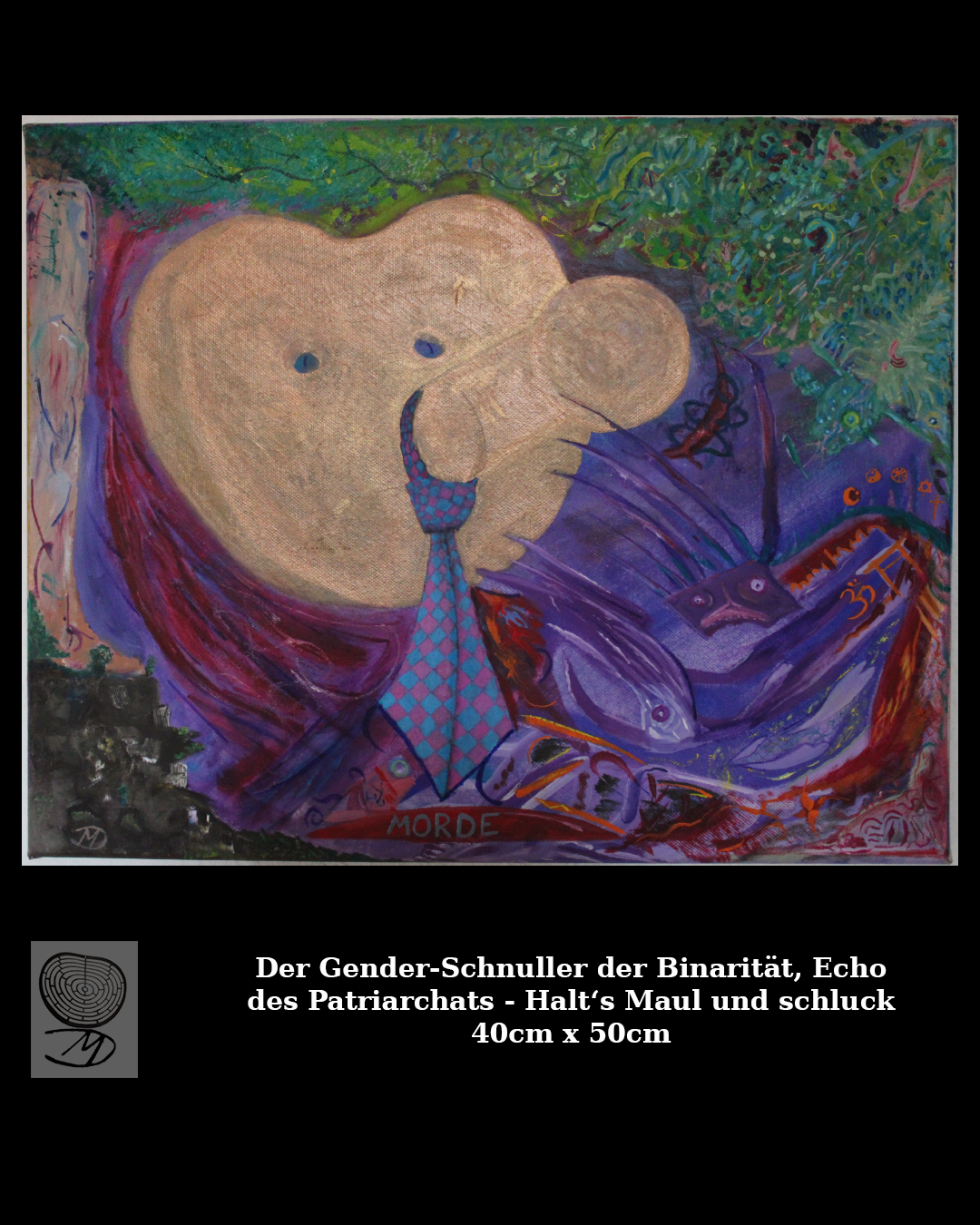
Der Gender-Schnuller der Binarität, Echo des Patriarchats - Halt's Maul und schluck
by Marco-Dominic Duschl
Published
26 views
- Genre
- Oil Painting
- Dimensions
- 40x50 cm
- Year
- 2026
Description
Bro is a code. The same kind of code as a dumb joke. Those who laugh along belong. Those who question it are outsiders. It’s often a deep, conspiratorial laugh, signaling connection but actually creating exclusion. In the world of Bros, this ritual is not just a test of camaraderie—it’s a mechanism that reinforces itself. You see it in student fraternities, in the police, in workplaces, and even in supposedly progressive circles. Bro culture is not just harmless male friendship; it’s an expression of power, built on loyalty, exclusion, and hierarchy.
Corps Spirit: When Brotherhood Becomes a Power Structure
This mechanism is especially clear in the police. On the surface, it appears to be about camaraderie in service of society. In reality, it is a disciplinary power that suppresses progressive ideas. Through discipline and loyalty, it protects itself and preserves its existence. Michel Foucault describes in Discipline and Punish (1975) that power does not primarily sustain itself through violence but through the constant self-surveillance of all parts of society. Those who call out wrongdoing are ostracized.
Thus, corps spirit is not just an expression of community but, above all, a strategy of control. It does not protect what is supposedly good—it protects its own structure. Studies like Bethan Loftus’s Police Culture in a Changing World (2009) show that loyalty to the group is often valued more than legal or moral principles. The same principle applies to many Bro networks: protecting the group takes priority over everything—even if it means covering up abuse of power or shielding perpetrators.
Patriarchal Denial Culture: How the System Protects Itself
A key mechanism that sustains Bro culture and corps spirit is patriarchal denial culture. This means that those who question behaviors or structures are not just ignored but actively labeled as the problem. Accusations of “overreacting,” mocking feminist critique, or the infamous “not all men…” argument do not serve genuine debate—they are defense strategies of a system that refuses to be questioned. These mechanisms are not harmless; they stabilize existing power structures by delegitimizing criticism before it can become effective.
The Invisible Order of Brotherhood
According to Judith Butler, masculinity is not something one is, but something one does. It relies on the constant repetition of behavioral patterns: rituals, codes, jokes, physical dominance—all to keep the system running. Those who comply belong. Those who deviate risk exclusion. In Gender Trouble (1990), Butler also describes that gender is performative—and the same applies here: masculinity must be continuously proven. But what appears to be a display of strength is often rooted in deep fear. Fear of not being “masculine enough.” Fear of standing alone.
This community remains stable by excluding the „Other.“ The Bro exists through what he is not—soft, reflective, uncertain. In this sense, Bros cling to their unity without ever being truly honest. To the Bro, his group seems like a genuine bond, but in reality, it is a fragile imitation of true, solidaristic connection.
Homosociality: Why the System Reinforces Itself
Why do these structures persist? The key lies in homosociality. Pierre Bourdieu describes in Masculine Domination (1998) that male networks reinforce themselves by presenting themselves as „natural.“ Men promote other men, Bros recruit other Bros, perpetrators protect perpetrators. This happens in the workplace, in social circles, and even in political movements. Homosociality ensures that power and influence remain in the same hands while alternative perspectives are excluded. Even the supposedly feminist Bro continues to operate within this circle, enjoying his privileges without truly questioning them. This contradicts feminism’s demand to break up these male alliances—so the feminist Bro inevitably entangles himself in contradictions.
Why Even „Feminist Bros“ Harm Feminism
Here lies the irony: Bros love freedom—but this freedom was won by feminism. Without feminist movements, gender roles would be far stricter, and sexual morality much more rigid. Bros enjoy the ease and choices that feminism has made possible. They benefit from a world they did not help create.
In summary:
Homosociality instead of true solidarity – Feminist Bros still surround themselves primarily with men, sharing power, knowledge, and recognition mainly within their own circles. FLINTA* (women, lesbians, intersex, nonbinary, trans, and agender people) are often seen as “allies” but rarely as true equal partners.
Irony as a shield – The ironic use of the word „Bro“ is a defense strategy: it allows feminist men to distance themselves from toxic masculinity while avoiding a true confrontation with their own socialization. The term „Bro“ remains a game, a code—and thus part of the problem. Defining oneself as a Bro means prioritizing male belonging over political values.
Male approval as priority – Even under feminist pretenses, many men still value the approval of other men more than radical change. The desire to be seen as a “good guy” outweighs the commitment to dismantling patriarchal structures. This prevents true solidarity and reinforces patriarchy. For example, many men are more likely to respect a woman’s rejection if she has a boyfriend than if she simply says no—their respect for an absent man outweighs their respect for the FLINTA* person herself.
Conclusion: The Power of Interruption
Bro culture and its associated corps spirit appear stable because they reinforce themselves. But they exist only as a performance, sustained through social reproduction. They present themselves as rebels, yet those who benefit from patriarchy while underestimating feminism’s achievements are not rebels—they are, at best, spoiled beneficiaries, and at worst, a direct threat to those who do not profit from this system. It’s time to acknowledge that.
Change can happen when we interrupt this patriarchal self-image—when men ask themselves why they define belonging through dominance. When they let go of the word „Bro“ and start seeking real connection. A world without exclusion doesn’t need codes—it needs the courage to be honest.